Dressing a woman the mosaic never dressed.
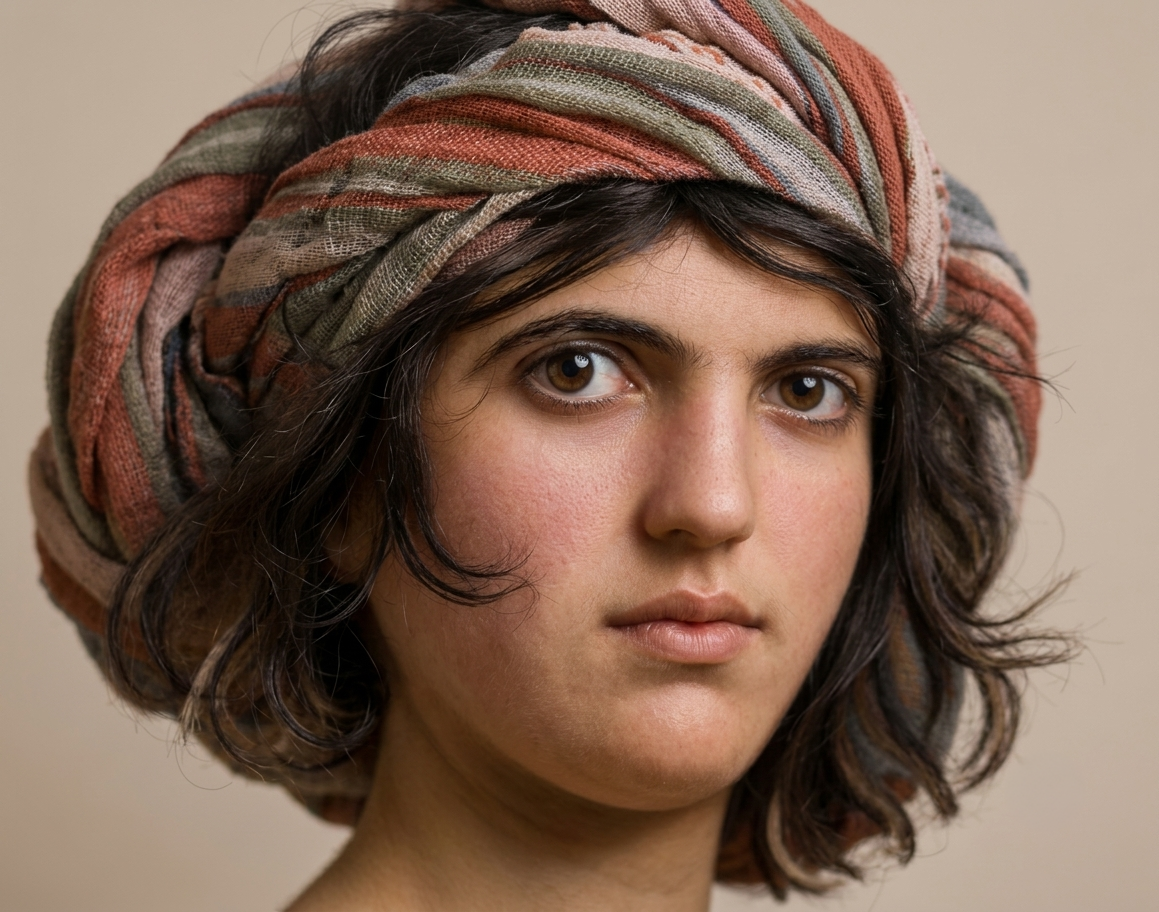
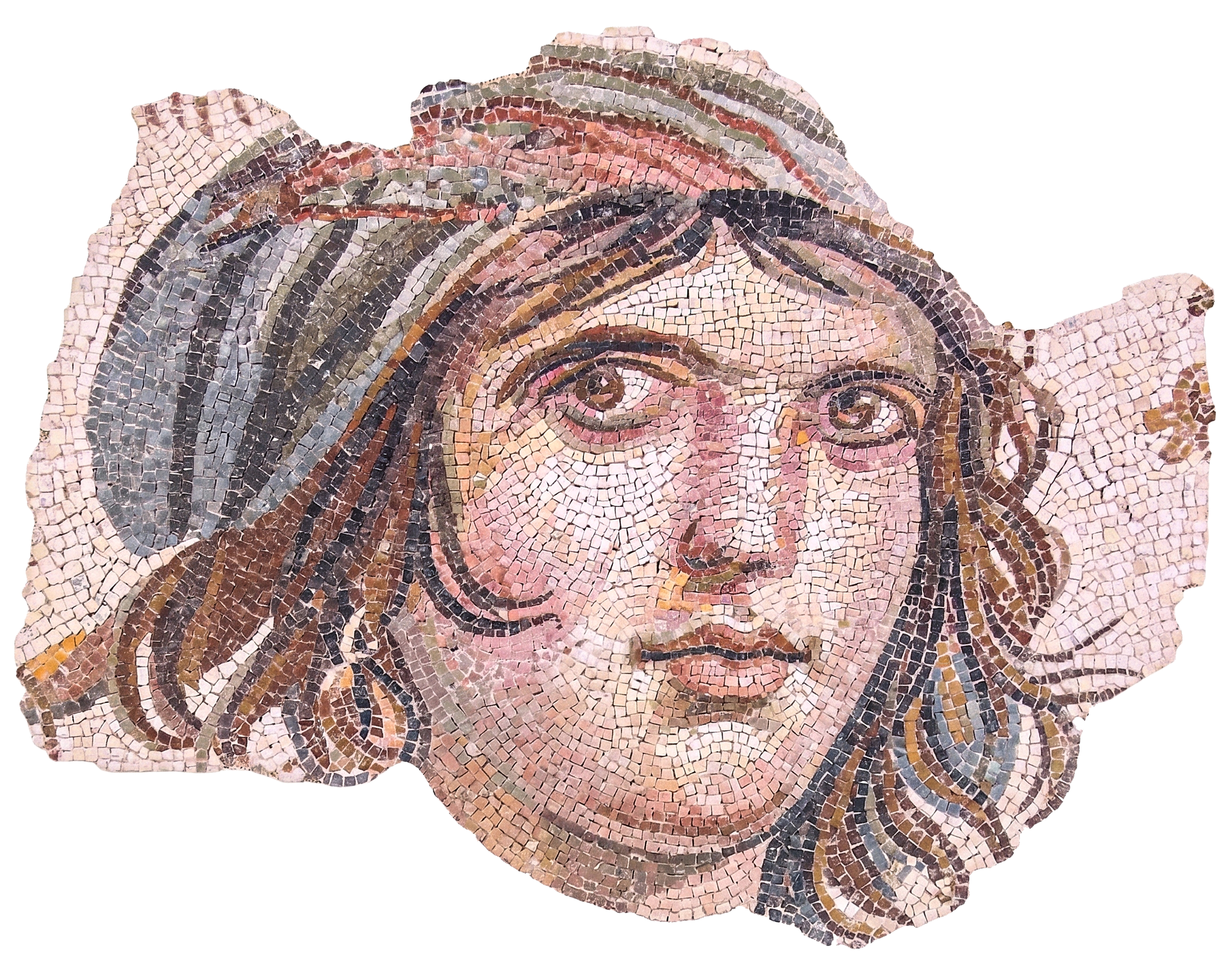
The Zeugma "Gypsy Girl" mosaic survives only from the collarbones up. Any clothing on her photoreal reconstruction is not restoration — it is invention, and every invention here was required to trace back to a cited source before it was allowed into a prompt. This page documents that chain: what we chose, what we deliberately rejected, and why.
 Photoreal reconstruction
Completed mosaic
Photoreal reconstruction
Completed mosaic
The mosaic face, and the photoreal reconstruction this case study dresses — drag to compare.
01 The evidentiary gap
The excavated fragment preserves the eyes, brows, nose bridge and the hair/head-wrap on the left side; the mouth, chin, jaw and everything below the collarbone are lost to breakage, not depicted[1]. A photoreal reconstruction that continues past the collarbone is therefore working in a zone with zero direct evidence. Our rule for that zone: nothing enters a generation prompt as clothing, color, or material unless it can be footnoted to a source about the right place and the right century — never "whatever looks Roman."
02 Where, and when, precisely
Zeugma was founded as a Hellenistic Greek city (by a successor of Alexander the Great, hence the Greek name) and only later absorbed into the Roman province of Syria[2]. The mosaic itself dates to the 2nd century AD[1]. Those two facts together matter more than "Roman" as a general label: a provincial city on the Euphrates with a strong Hellenistic substrate dressed differently than the city of Rome did, and Rome's own fashion had moved on by this date too. Both corrections below follow directly from taking the place and the date literally instead of defaulting to a generic "toga-and-stola" image of antiquity.
03 Garment system — chiton + himation, not stola + palla
The reflex choice for "Roman woman" is the stola (a long belted tunic) with a palla draped over it — but two facts rule it out here. First, chronology: the stola was a status garment restricted to Roman citizen matrons, and by the early 2nd century AD it had already fallen out of general use, even in Rome itself[3]. Second, geography: Zeugma's Hellenistic founding means the ambient dress convention was Greek, not Italian — the chiton (a rectangular length of cloth pinned at the shoulders) worn under a himation (a draped outer cloak) is the garment pairing actually documented for this cultural zone[4].
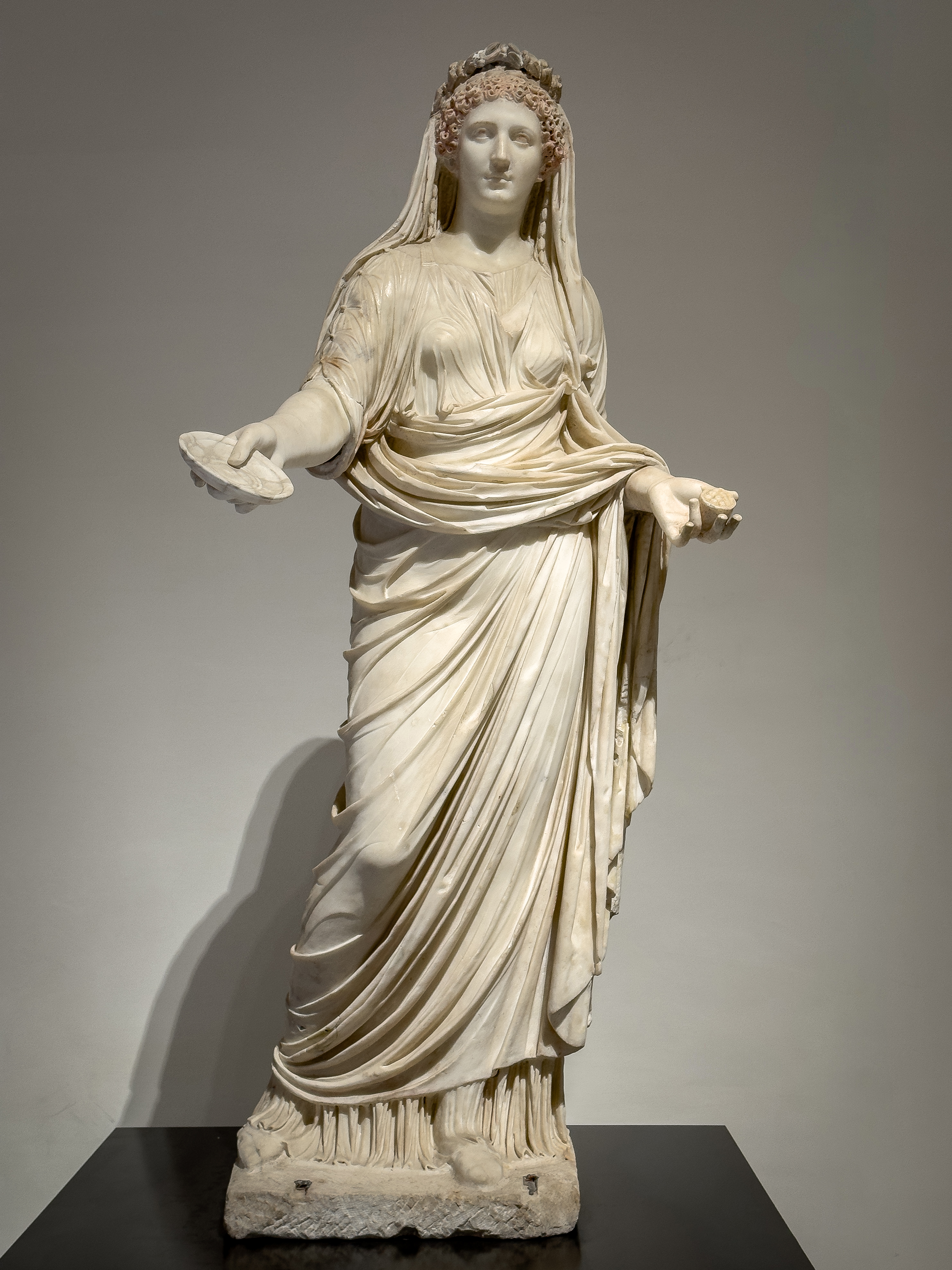
Stola + palla — a Roman citizen-matron's garment, already obsolete by the mosaic's own century.
Marble statue of a priestess, perhaps the empress Livia, Pompeii macellum. Photo: Chappsnet, CC BY-SA 4.0 — Wikimedia Commons
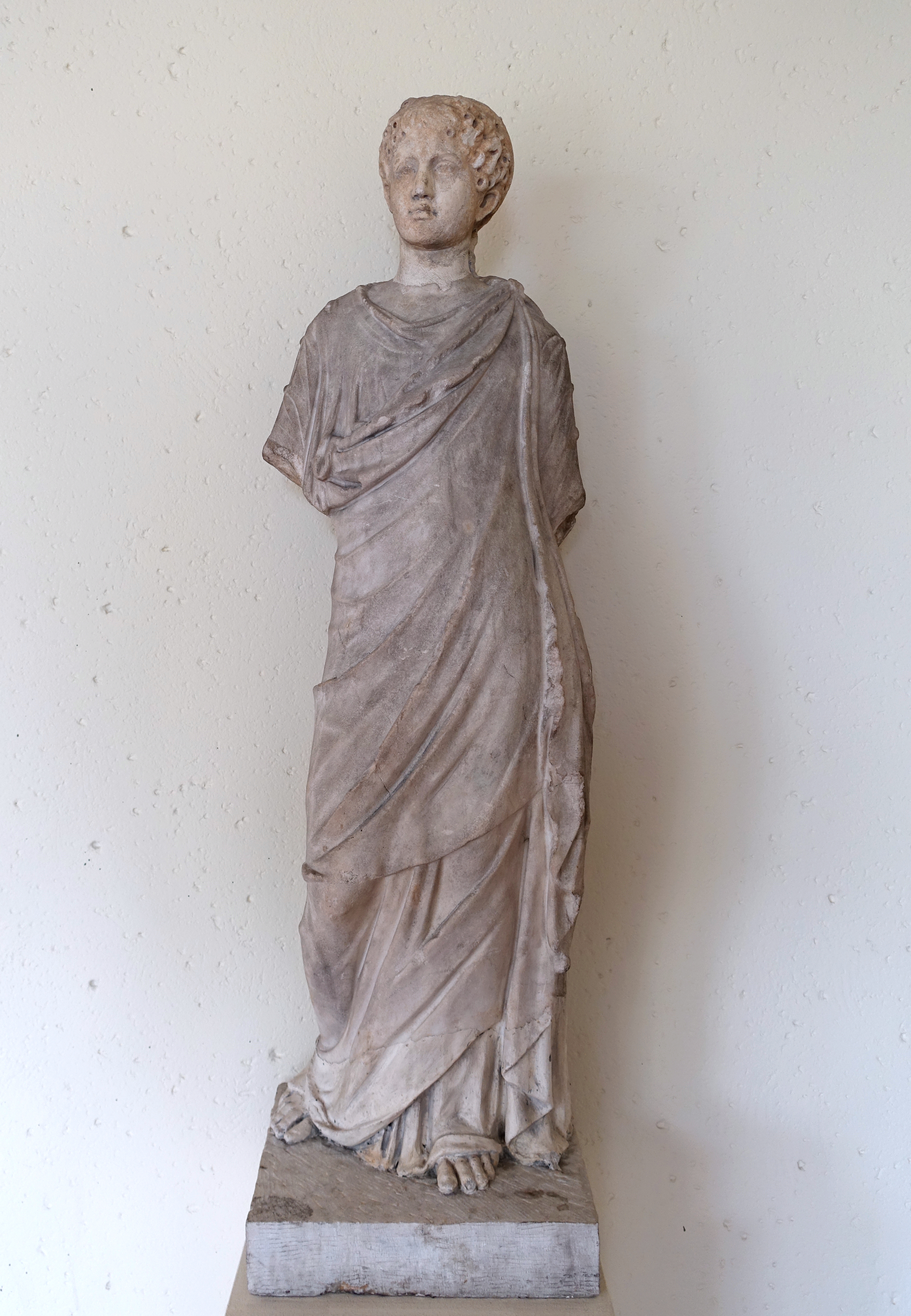
Chiton + himation — the region's actual convention, and dated to the same century as the mosaic.
"Statue of a young woman in chiton and himation… 2nd century AD," Cinquantenaire Museum, Brussels. Photo: Daderot, CC0 — Wikimedia Commons
04 Iconographic register — daily dress, not Maenad attributes
Popular literature reads the mosaic as either a real girl ("Gypsy Girl"), a Maenad (an ecstatic follower of Dionysus), or the earth-goddess Gaia — the identity is genuinely unresolved among sources[5]. Maenads carry a specific iconographic marker: the nebris, a fawn-skin tied over one shoulder that leaves the other bare, worn as a mark of ecstatic Dionysian ritual[6]. Dressing the reconstruction in a nebris would silently pick a side in a debate the mosaic itself does not settle. So the working rule was: plain, humble daily dress only — a costume that is historically present in the region without asserting which of the three readings is correct.
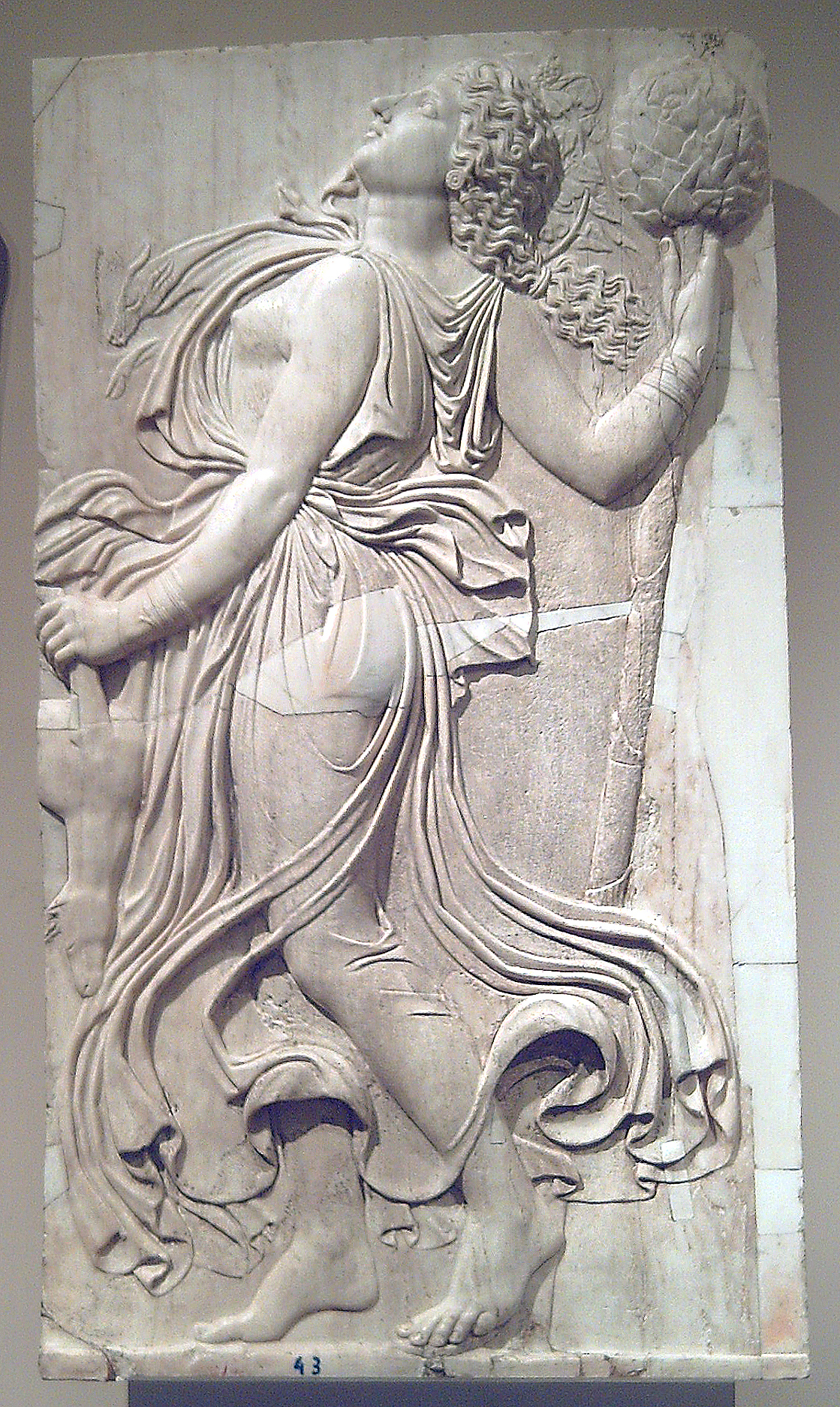
Nebris over one bare shoulder — the specific costume marker of "Maenad," not "young woman."
Roman relief of a dancing maenad, 120–140 AD, marble — Roman copy after a late-5th-c. BC Athenian original attributed to Callimachus. Museo del Prado, Madrid. Photo: Luis García, CC BY-SA 2.0 — Wikimedia Commons
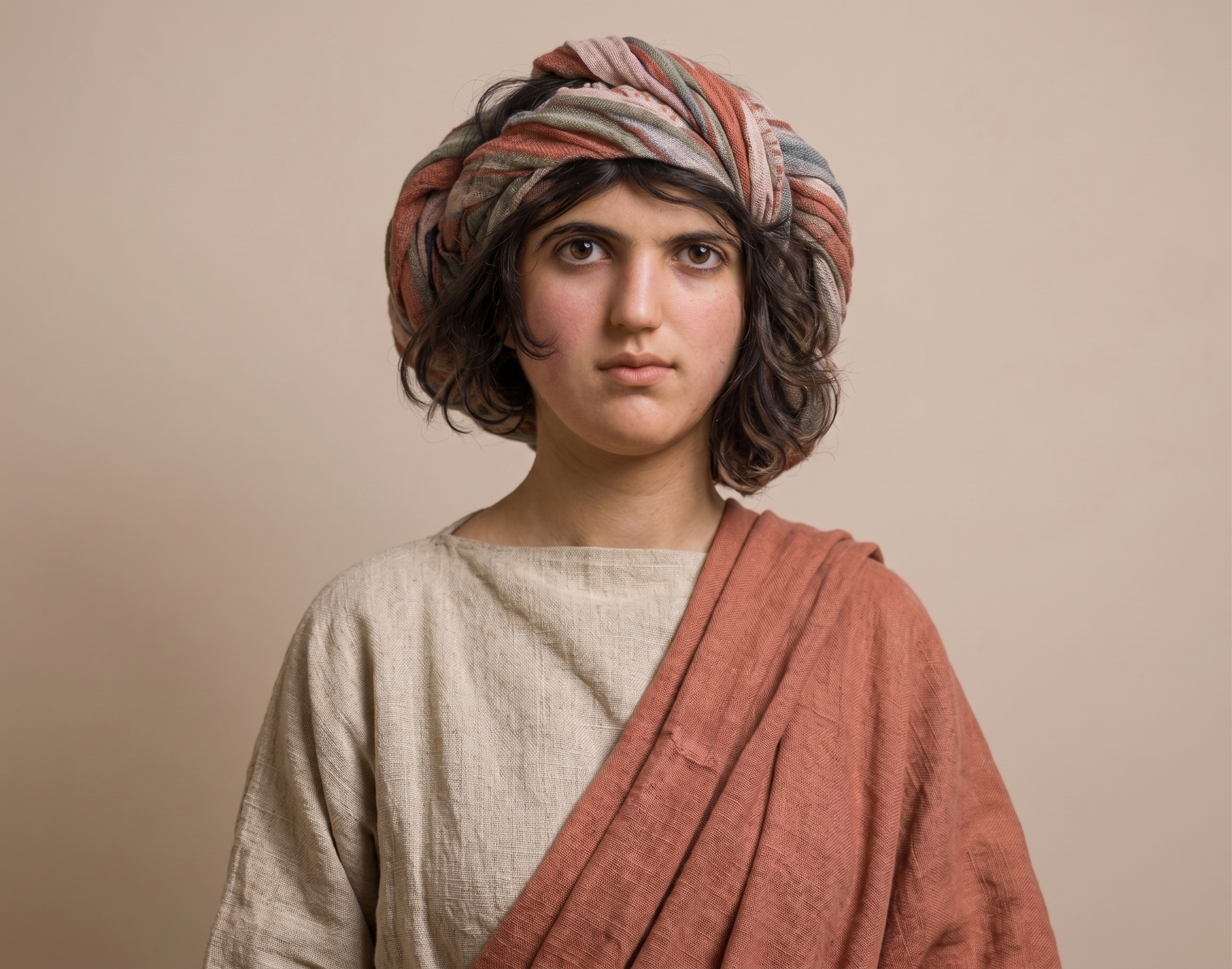
Both shoulders covered, no fawn-skin, no ritual attribute — the neutral reading, applied to the reconstruction.
promptbricks photoreal reconstruction, generated for this case study.
05 Material and palette — provincial linen, not senatorial dye
Undyed or lightly dyed linen was the working population's everyday cloth; rich, saturated dye (particularly the whites and purples associated with status) marked wealth and office, which nothing about this figure's context supports. The province was itself a linen-producing region — Syrian linen was rated among the finer grades available in the empire[3]. The reconstruction's chiton and himation were therefore specified in cream, oat and faded terracotta — undyed-to-muted tones consistent with ordinary provincial cloth, not the bright white of a citizen's formal dress.
06 Hem and footwear
Women's tunics in the period ran longer than men's, commonly to the ankle or the ground[3], so the reconstruction's chiton was specified to fall at ankle length rather than knee length. For footwear, the sandalium/solea — a flat leather sole tied across the foot and around the ankle with thin straps — was the ordinary, gender-unspecific informal shoe of the period, as opposed to a closed shoe or an ornate laced boot[7].
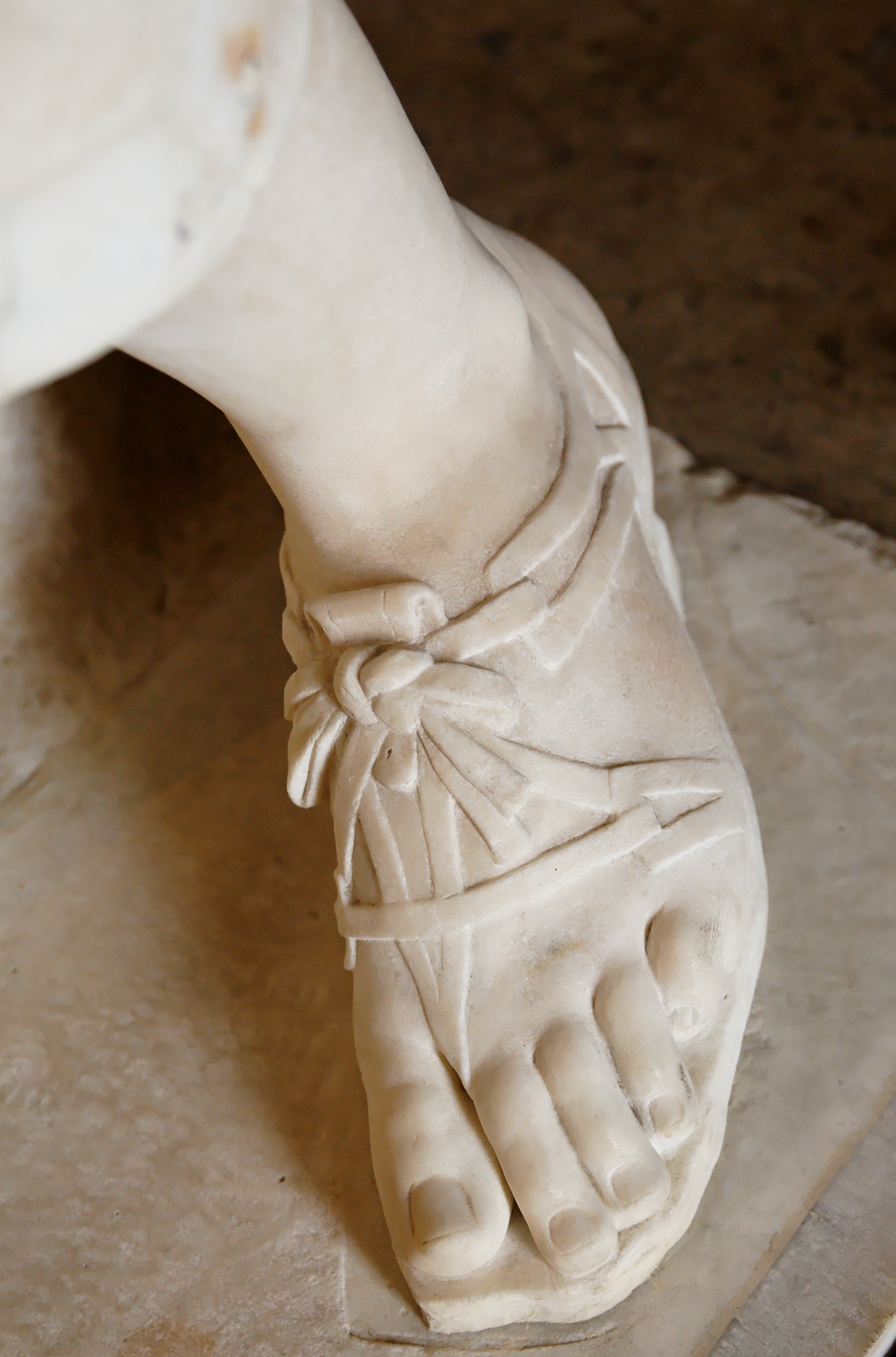
Flat sole, thin ankle straps — the plain sandalium/crepida form used as the footwear reference.
Detail, "Artemis of Gabii," Louvre Ma 529. Photo: Marie-Lan Nguyen (Jastrow), 2007, Public Domain — Wikimedia Commons
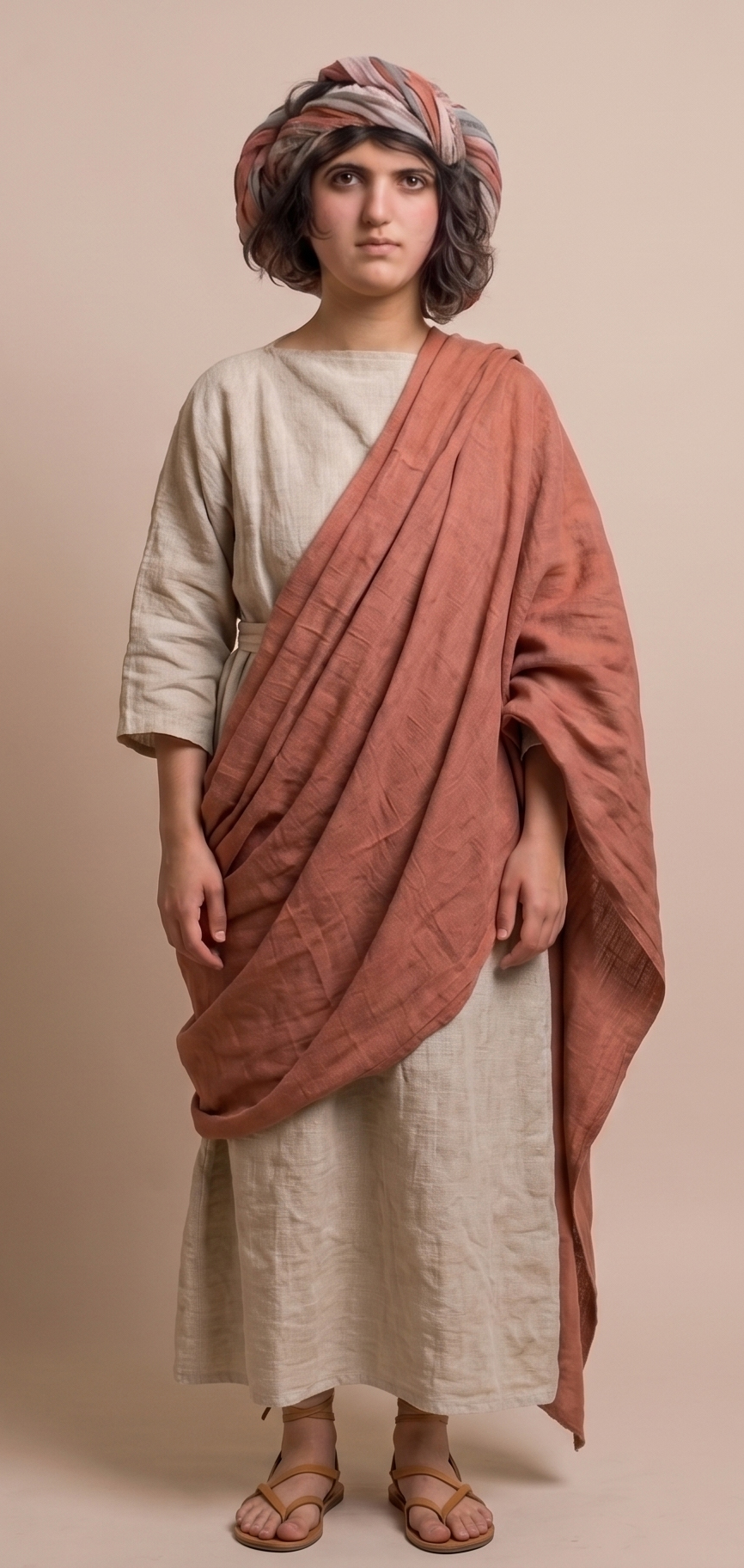
Full-length hem and sandals, applied together in the standing reference.
promptbricks photoreal reconstruction, generated for this case study.
07 Applied result
Chiton and himation in undyed provincial linen, no ritual attribute: the decisions above, combined into a single costume and applied consistently to the reconstruction.
Front reference — face identity and costume locked together in one image.
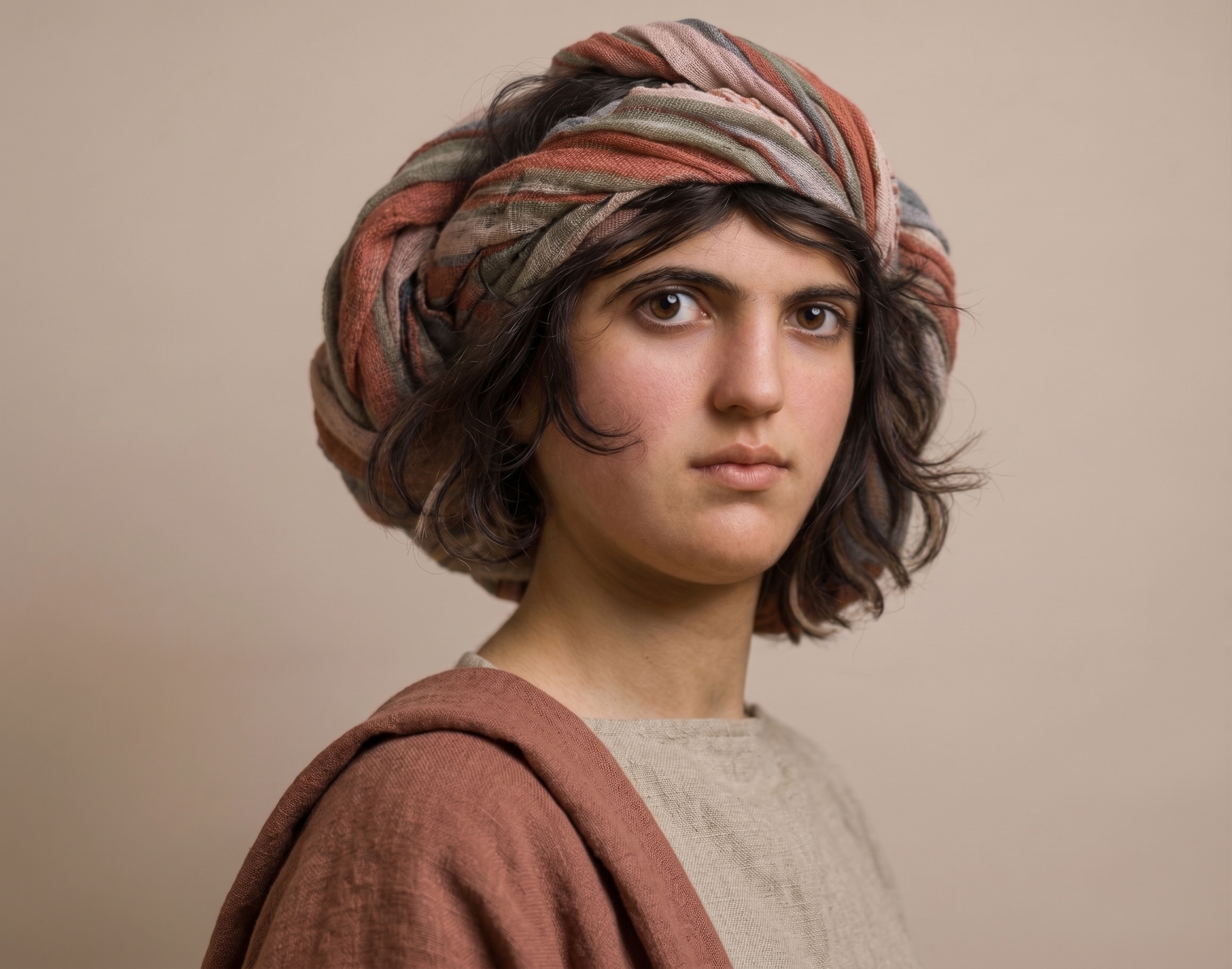
Three-quarter turn, generated from the same locked identity + costume reference.
— Sources
- [1] Zeugma Mosaic Museum — "Gypsy Girl" mosaic, 2nd century AD, excavated 1998, Gaziantep, Türkiye. Google Arts & Culture — The Magnificent Mosaics of Antiquity
- [2] Zeugma's Hellenistic founding and Roman-Syrian provincial context. Faraway Worlds — Zeugma Mosaic Museum: mosaics and myths in southern Turkey
- [3] Stola decline by the 2nd century AD; women's tunic length; Syrian linen quality. Wikipedia — Stola, Roman-Empire.net — Roman Dress
- [3b] Regional textile/material context. History and Archaeology Online — Roman Women's Clothes
- [4] Chiton and himation as the standard Greek/Hellenistic female garment pairing. Wikipedia — Himation, Wikipedia — Chiton (garment)
- [5] Unresolved identity debate — Gypsy Girl / Maenad / Gaia. Alamy — Gaziantep Museum, the Gypsy Girl / Maenad mosaic
- [6] Nebris as Maenad-specific iconographic attribute, worn over one shoulder leaving the other bare. Wikipedia — Nebris (mythology), Wikipedia — Maenad
- [7] Sandalium/solea as the common informal, gender-unspecific footwear of the period. Encyclopedia.com — Solea
All external images are used under their stated Wikimedia Commons license (CC0, CC BY-SA 2.0, or CC BY-SA 4.0) with photographer and source credited inline above. The mosaic and all reconstruction images are part of promptbricks' own restoration work for this case study.